RV power check
Will the PECRON F3000LFP close your RV power gap?
You started with this product. The check may confirm it, eliminate it, or identify a more appropriate setup.
The one thing the reel did not settle
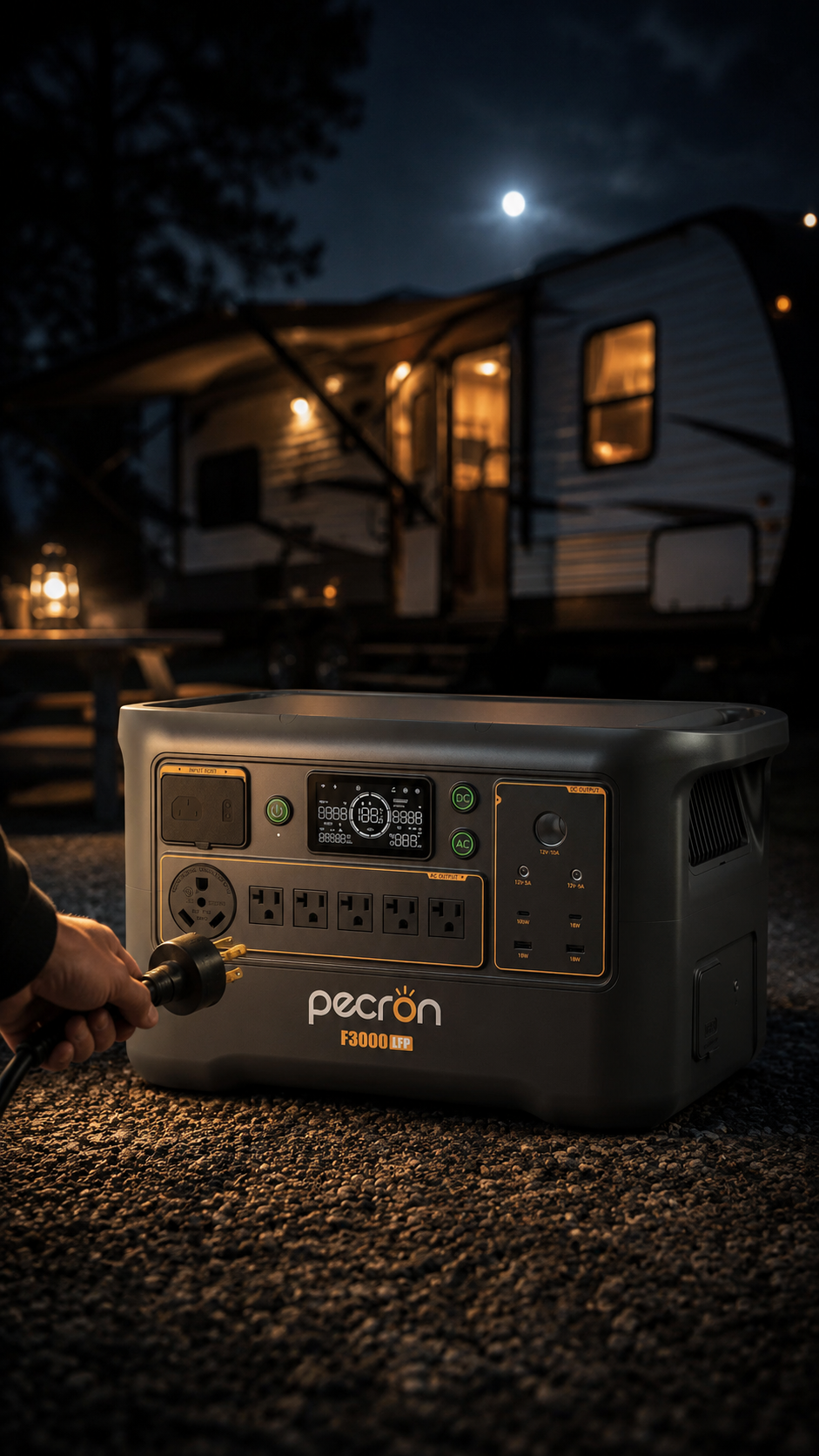
The cable is in your hand and nothing is plugged in yet: the open question is whether your 30 A trailer inlet and its largest motor start fit inside the documented surge envelope — not how many watt-hours the box holds.
Mission diagram, candidate hypothesis, local proof and commercial gates
- 1. Load30 A inlet, air conditioner or compressor start
- 2. Duration / energyNights off shore power, energy needed
- 3. RechargeSolar, driving or shore power the next day
- 4. Limit / verdictSurge gate: the start passes, or it does not
Mission diagram — load, duration, recharge and the limit that decides. Not a product measurement.
Candidate under test
PECRON F3000LFP
Hypothesis only — a candidate to verify, never a winner. This page does not rank brands and the check can conclude that this unit does not close your setup.
Its published capability is recorded in the catalogue. What is still open is your own start profile, declared by you in the check.
US electrical scope
120 V / 60 Hz
NEMA 5-15 household outlet
TT-30R, 30 A recreational-vehicle inlet
US mission context: shore-power pedestal, 30 A trailer service.
This scope is US-only and is never applied to a European surface.
Merchant readiness — the four real gates
The state below is read from the project catalogue. No stock, price, delivery, warranty or commission is asserted here.
- 1. Exact US variant / SKUExact US model and variant recorded in the catalogue.
- 2. Live stock and orderabilityIts official page states warehouse arrival is expected; it is never described as in stock or shipping now.
- 3. Accepted affiliate programme and stable deep linkAffiliate programme active for this brand; the destination stays gated until stock is live.
- 4. Tracked click, visible in BtB and in the networkCommercial verification in progress.
One or more gates are open, so no merchant call to action is offered on this page.
Answer first, before any question
May fit under conditions
The Reel put the F3000LFP against a 30 A RV mission with a high-power load. Which mission should be tested for you? The exact appliance is identified in the full check.
This is the answer most likely to change the verdict.
The mission can be carried, but the day does not yet close on its own.
Start the RV power check with the PECRON F3000LFP as your candidate. Its native TT-30R RV outlet passes 3,600 W continuous, and the check may confirm it, rule it out, or name a different architecture.
Low / insufficient confidence — no unit is recommended at this level of evidence.
What this answer assumes (5)
- A two-night weekend
- Essential loads only
- No air conditioning
- No recharge credited
- An existing house battery system is not credited
Evaluate the PECRON F3000LFP as a candidate for this RV mission.
PECRON F3000LFP — High-output 3 kWh class
- Same deterministic engine as the standard check.
- This unit is a candidate, not a verdict.
- No email, and no brand ranking.
This exact model's capability is documented, not pending.
- 3,072 Wh of stored energy, recorded from the exact US model.
- 3,600 W continuous at 120 V, with a native TT-30R 30 A RV outlet.
- Published surge envelope of 4,500 W for 5 seconds.
- AC recharge input of 1,800 W.
The one question still open is yours, not the unit's: whether your own compressor or air-conditioner start fits inside that documented 4,500 W / 5 s envelope. The check answers it from the starting watts you declare.
Ordering for this exact model and variant is open; its official page states warehouse arrival is expected next week, so it is never described as in stock or shipping now.
No exact-unit image is shown on this page: the check, not a picture, decides whether this model fits.
Availability, affiliate status and evidence for this exact model
Affiliate program active for this brand, and this exact model can be ordered from its own official product page today: checkout opens for the exact model, while that page states warehouse arrival is expected next week — so it is not described as in stock or shipping now. No link is offered on this page: an exact-model destination appears only if the check itself selects this unit. Affiliate status never qualifies a unit and never changes its order.
What this page does, and does not, do
- It preselects a candidate hypothesis, never a verdict. Your answers, not this page, decide the result.
- It runs the same canonical diagnostic and the same deterministic engine as the standard check. There is no second rule set and no shortcut.
- It can conclude that this unit does not close your setup, that no unit in the catalog does, or that one fact is still missing before anything can be named.
Method
The RV check separates the finite mission (can the trip be closed at all?) from the daily loop (does the energy come back each day?). Motor starts are a separate pass/fail gate: a unit that has capacity can still fail a compressor start, and an undeclared start is never treated as proven.
Limits
- No price, no stock, no runtime and no comparison win is asserted anywhere on this page.
- Manufacturer marketing figures are recorded as labeled claims and are never used as generic runtime input.
- A unit may be named as a candidate with one fact missing. It is never recommended, and never given a purchase link, until that fact is closed.